Join the Agüita Club for free: wine stories every two weeks and priority access to our tastings.
white wine
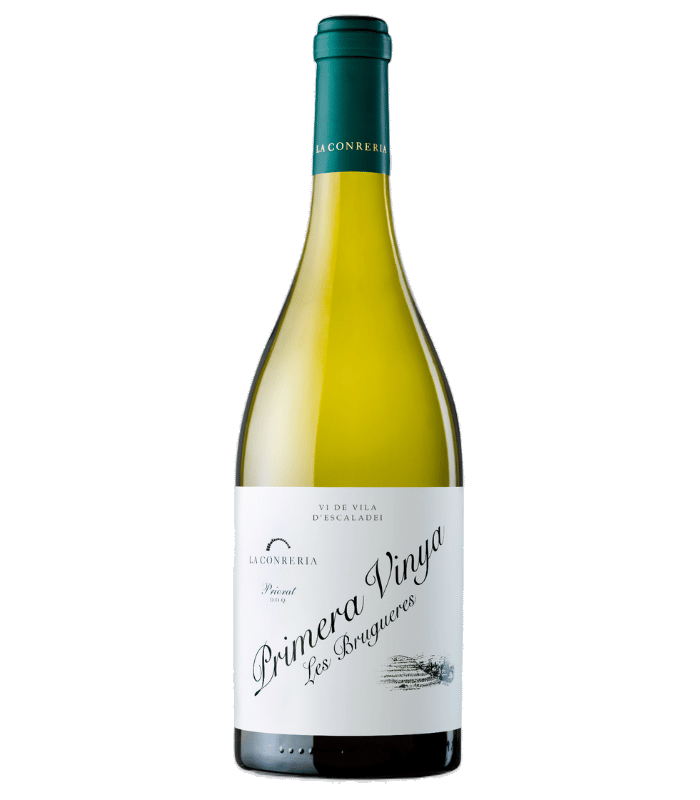
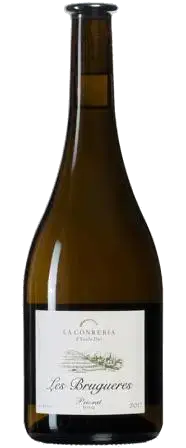
La Conreria d’Escaladei – Primera Vinya – DOQ Priorat
€48,00
Garnacha Blanca
Fermentation at 15ºC in 400-litre French oak barrels. Preserved and aged on lees in the same barrel for 9 months. Limited production of three barrels.
Description
Garnacha Blanca
Vineyards:
Les Brugueres-Corrals d’Escaladei.
Process:
First part of fermentation with indigenous yeast. Maceration on skins for 48 hours. Fermentation at 15ºC in 400-litre French oak barrels. Preserved and aged on lees in the same barrel for 9 months. Limited production of three barrels.
Tasting:
Intense nose of stone fruit, with clear notes of incense, cut hay and mint on the finish. Slightly tannic on the palate, with a glyceric presence, the oak is noticeable while respecting the wine’s character, with excellent acidity balance, quite lively. Long aftertaste.
Pairing:
Fish, seafood, rice dishes, cheeses and white meat.
Alcohol: 14%
Serving temperature: 10ºC
La Conreria d’EscalaDei

Priorat – Where every stone holds silence
Priorat is a surprising landscape due to its orography. It divides the Mediterranean from the heights of Montsant. In these slate soils, the monks of the Carthusian Monastery of Scala Dei marked out, eight centuries ago, the land that today is the modern and thriving Qualified Designation of Origin of Priorat.
A region whose economic and social life revolves around its agricultural vocation and, very particularly, around wine. A land recognised in 1974 by the F.A.O. for its unique quality and conditions that allow some of the best wines in the world to be produced here.
The name of our winery carries within it a history and a legacy that lead us back to a thousand-year-old tradition. Proud of it, we honour this land, taking special care of vineyards of different types and varieties, wisely distributed across different parts of the region, so as to create wines with their own personality.
In Priorat every door, stone or wall holds silence, rest and a vitality that gives everything meaning. A place where passion and knowledge make possible this miracle: the creation of a great wine.
Here our wines are born and raised, joining forces with time, to convey the essence of a young, modern winery that looks to tradition and, harvest after harvest, perfects its craft.
We invite you to discover and share our treasured world.
The winery – Wines with a mark
Annual production 130,000 bottles
Founded in 1997
La Conreria d’Scala Dei was born from the will and enthusiasm of a group of people historically linked to Priorat, with the desire to share with the world the magnificent wines produced in this land.
Starting from the former estate of the Rialp manor house, we have modernised its facilities to produce our wines and share the historical legacy of this land and its people, in the magnificent surroundings of Scala Dei and Priorat, with our visitors.
With a careful selection of vineyards and grapes, from the 52 hectares we lease and own, and with our effort behind each of the 130,000 bottles we produce annually, we bring to life these wines bearing the distinctive mark of Priorat.
The winemaker
Only the strength of a dream could reach where determination alone was not enough
“Wine always tells a story. The scent of an ancient land carrying the colours of time. Priorat has captivated me. My studies together with experience have shaped me as a winemaker. But skill is not enough, nor is recognition. Only the strength of a dream could reach where determination alone was not enough.
This is how La Conreria d’Scala Dei was born. A simple culture built on humility and coherence. La Conreria’s wine holds all of this.
Every day we strive to create something unique and precious, seeking the balance between strength and gentleness.
As a reflection of the times we live in, Priorat has known how to adapt. It has transformed its unique richness into a catalyst, and I do nothing more than interpret the signs of a modernity rooted in tradition.
La Conreria’s wines are born from respect for an essential natural heritage, where words make room for the impressions gathered in each glass, telling of times past and times to come.”
Jordi Vidal
Winemaker and Co-owner
Our wines.


DOQ Priorat

Priorat is a Qualified Designation of Origin (DOQ or DOCa) for Catalan wines produced in the Priorat region, in the southwest of Catalonia.
The DOQ covers 11 municipalities. It mainly produces powerful red wines, which gained international attention in the 1990s. The area is characterized by its unique terroir of black slate and quartz soil known as llicorella.
It is one of only two wine regions in Spain to be classified as DOCa, the highest level of qualification for a wine region according to Spanish wine regulations, along with Rioja DOCa.
The place name Priorat has been linked to the concept of wine for centuries. The combination of soil, climate, orography and the work of men and women who have produced it following the techniques of a thousand-year-old tradition with the help, today, of technology adapted to the requirements of quality, have resulted in an authentic, exclusive product: Priorat wine.
The Carthusian Monastery of Scala Dei represents the historical cradle of wines and viticulture of the Priorat Qualified Designation of Origin. The Carthusian monks brought from Provence, in the 12th century, the knowledge and techniques to develop a viticulture that took strong root and has evolved over the centuries. The domains of the Carthusian Monastery formed the so-called historical Priorat, which today coincides with the wine-growing region of the DOQ Priorat.
The story goes that King Alfonso I the Chaste sent two knights to travel the country to find a suitable place for the Carthusian order, coming from Provence, to settle in Catalonia. Once they arrived at the foot of Montsant, the singular beauty of the place caught their attention and they asked a shepherd about the enclave. In addition to informing them, the shepherd told them about a supernatural event that had been happening for a long time in the heart of that valley: on the tallest pine tree a ladder appeared where angels ascended and descended.
King Alfonso I offered that place to the order. The Carthusians, established in 1194, erected the altar of the temple dedicated to Santa Maria at the point where the legendary tree stood. History gave the monastery its name and at the same time generated an iconography strongly rooted in the territory.
The Carthusians of Scala Dei cultivated the vineyard and produced the wine in the Carthusian Monastery, following a school of work and spirituality. They were dressed in white wool, with a hood that covered their shaved heads. Perhaps Priorat is a mystical wine.

Today, the ruins of the Carthusian monastery provide a breath of mystery and attract visitors. Above these ruins, different geological layers overlap to the top of the mountain, playing with a varied palette of colours, from grey, ochre and yellow to brown and red, so forming this mystical stairway that reaches up to the blue of the sky and the white of the angels in the clouds.
For nearly 1,000 years, nine small villages have been settled among the slopes of slate that lie scattered at the foot of the Sierra del Montsant. Their inhabitants, winegrowers throughout that time, shaped the land with terraces. After the Mendizábal Confiscation (1835), thanks to great effort and the growing development of the vineyard, the winegrowers rediscovered their dignity. This deep change has generated an extraordinary culture, a source of prestige for this country. Among other examples, the vine-growing culture has endured among the inhabitants of this territory, and there are historical accounts as old as the chapter «How to plant a vineyard in Scala Dei», from the «Book of Vassals» of the 17th century, or the anonymous text «Manual of viticulture of Porrera of the 18th century», reflecting the wisdom of people living in harmony with nature.
Unfortunately, times of harmony and growth are cyclical and often end in disasters. In fact, in the history of European agriculture and viticulture, there is a before and after the phylloxera plague. In Priorat it was also a catastrophe in the late 19th and early 20th centuries, since at that time the boom of the textile industry in Catalonia drew the entire workforce toward the cities, and new vines were not replanted, except on a small scale, which, fortunately, is what has endured to this day.
Thanks to the generation of farmers now between 70 and 80 years old, who have remained on the land and continued the agricultural tradition, the wine-growing culture has been preserved in Priorat.
In recent decades it became possible to work with a preserved landscape, complex, rich and of formidable potential. It was, then, at the end of the 1980s when a new cycle of prosperity began, combining wisdom, landscape and tradition with a new entrepreneurial spirit whose main aim was the recovery of quality and prestige.
The rehabilitation of the vineyards was carried out slowly, with the certainty that it had to take root in the memory of the land. In a curious blend that brings together the evolution of a traditional culture with agrarian remnants of the past and an exuberant nature, through respectful and efficient replanting.
Additional information
| type of wine | white wine |
|---|